Introduction
Arthritis affects over 50 million adults and 300,000 children in the United States alone, making it one of the most common chronic conditions worldwide. Characterized by joint pain, stiffness, swelling, and reduced mobility, arthritis encompasses more than 100 different types—with osteoarthritis and rheumatoid arthritis being the most prevalent.
While conventional treatments including NSAIDs, corticosteroids, and biologic therapies remain the standard of care, many patients seek natural, non-invasive alternatives. Hyperbaric oxygen therapy (HBOT) has emerged as a promising option backed by decades of research.
What Is HBOT?
HBOT involves breathing nearly 100% pure oxygen inside a pressurized chamber, where atmospheric pressure is elevated above normal levels. Under these conditions, oxygen dissolves more efficiently into the bloodstream—providing up to 20 times the normal oxygen concentration to tissues throughout the body. This triggers reduced inflammation, enhanced cellular repair, and modulation of immune function.
HBOT Pressures: 1.5 ATA vs. 2.0 ATA
The Undersea and Hyperbaric Medical Society (UHMS) defines therapeutic pressure as not lower than 2.0 ATA. However, emerging research shows that lower pressures (1.3–1.5 ATA) affect different biological pathways, making them complementary rather than competing approaches.
• 1.5 ATA – The Investigational Threshold
A 2014 study in *Pain Physician* examined hyperbaric therapy in a rat model of arthritis, exposing subjects to 1.5 ATA for 1, 3, or 5 hours daily over 12 days. The 3-hour group showed a smaller MMP-9/MMP-2 ratio—a marker of inflammation—compared to controls. The study concluded that the effect of hyperbaric treatment depends on elevated therapy time under 1.5 ATA pressure. Research indicates that 1.5–2 ATA with 60 minutes of treatment appears safe, with no serious side effects reported. Lower pressures are often preferred for chronic inflammation reduction.
• 2.0 ATA – UHMS-Approved Therapeutic Pressure
A landmark 2017 study published in *Undersea & Hyperbaric Medicine* investigated whether HBOT could prevent collagen-induced arthritis in mice. Animals received 90 minutes of 100% oxygen at 2.0 ATA daily. Six weeks later, joint swelling and inflammatory tissue damage were significantly less severe in treated mice. The therapy restored immune balance from pro-inflammatory Th17 cells toward anti-inflammatory regulatory T cells (Tregs). A 2025 comparative study found that 2.0 ATA affects approximately five times more epigenetic sites than lower pressures.
Clinical Evidence Summary
• For Rheumatoid Arthritis: A 2016 case report documented three RA patients who experienced significant, unanticipated improvement in joint pain, increased activity, and improved sleep following HBOT. The authors concluded that HBOT “may result in decreased joint pain, increased activity level, improvement in sleeping patterns and possibly a decreased need for standard rheumatologic medications”. A 2020 pilot study confirmed that HBOT is effective for joint pain in RA patients based on multiple validated clinical measures. A 2023 MRI pilot study found that RA patients receiving 30 HBOT treatments demonstrated no radiologic progression of erosions or synovitis at 3- and 6-month follow-up.
• For Osteoarthritis: A 2025 randomized controlled trial of 70 patients with knee osteoarthritis found that HBOT significantly reduced joint inflammation and improved clinical outcomes compared to conventional rehabilitation alone.
A 2025 comprehensive review of all relevant literature published in the past decade found that HBOT demonstrated an efficacy rate of 87.5%–100% in treating rheumatic and autoimmune diseases complicated by skin ulcers. Adverse effects were primarily mild—including barotrauma, tinnitus, and headache—and all resolved upon treatment discontinuation.
Safety Considerations
HBOT is generally safe when properly administered. The 1.5–2 ATA range with 60-minute sessions appears well-tolerated. However, patients with certain conditions—such as respiratory infections, inner ear issues, or pneumothorax history—should consult their healthcare provider before beginning treatment.
Other Natural Approaches
• Yoga: A 2014 study found that an eight-week yoga program was feasible and beneficial for older women with knee osteoarthritis.
• Massage Therapy: A 2012 dose-finding trial established that 60 minutes of Swedish massage once weekly over eight weeks represents an optimal protocol for knee osteoarthritis.
• Exercise: The CDC recommends at least 150 minutes of moderate-intensity aerobic activity weekly for arthritis sufferers, emphasizing low-impact, joint-friendly movements.
Conclusion
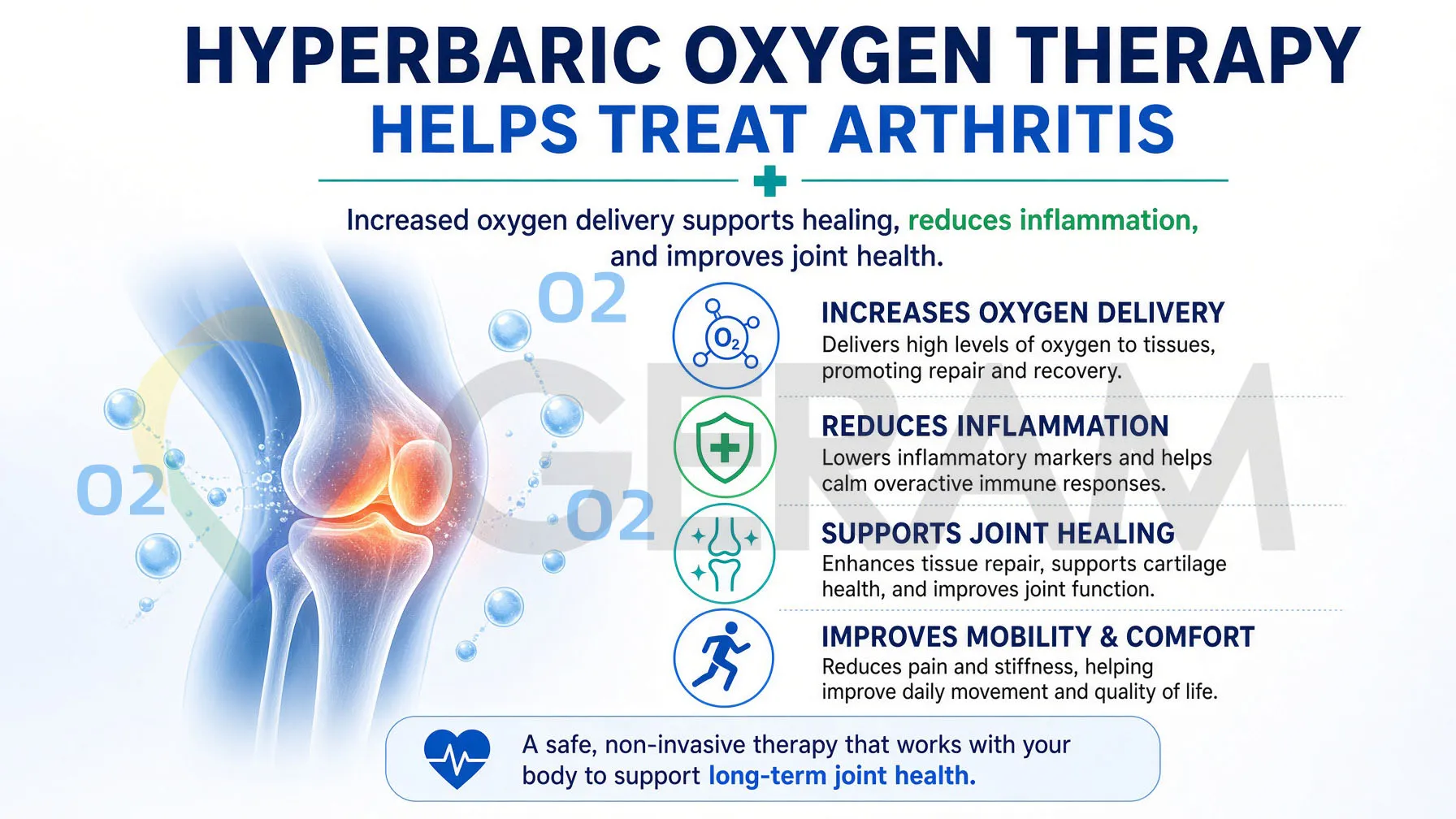
HBOT offers a natural, non-invasive approach to managing arthritis by reducing inflammation, modulating immune function, and promoting tissue repair. Both 1.5 ATA and 2.0 ATA protocols have demonstrated efficacy—with 1.5 ATA preferred for chronic management and 2.0 ATA for more aggressive intervention. When integrated with exercise, stress reduction, and other natural approaches, HBOT has the potential to significantly improve quality of life for those living with arthritis.
References
1. Slade JB, Potts MV, Flower AM, et al. Pain improvement in rheumatoid arthritis with hyperbaric oxygen: report of three cases. Undersea Hyperb Med. 2016 Jul-Aug;43(4):467-472. PMID: 28763177.
https://pubmed.ncbi.nlm.nih.gov/28763177/
2. Fang J, Li W, Liu C, et al. Clinical efficacy and mechanisms of hyperbaric oxygen therapy in the treatment of rheumatic and immune diseases. Front Med. 2025 Dec 18. doi: 10.3389/fmed.2025.1706637.
https://www.frontiersin.org/journals/medicine/articles/10.3389/fmed.2025.1706637/full
3. Hyperbaric Oxygen Therapy Pressures Explained: 1.3ATA, 1.5ATA, and 2.0ATA Applications. Geram Health.
https://www.hyperbaricgeram.com/blog-detail/hyperbaric-oxygen-therapy-pressures-explained-13ata,-15ata,-and-20ata-applications
4. Sit MT, Schmidt TW, Edmonds LD, et al. The Effects of Hyperbaric Oxygen on Rheumatoid Arthritis: A Pilot Study. J Clin Rheumatol. 2020;27(8):e462-e468.
https://journals.lww.com/jclinrheum/Abstract/2020/12000/The_Effects_of_Hyperbaric_Oxygen_on_Rheumatoid.1.aspx
5. Perlman AI, Ali A, Njike VY, et al. Massage therapy for osteoarthritis of the knee: a randomized dose-finding trial. PLoS One. 2012;7(2):e30248. doi: 10.1371/journal.pone.0030248.
https://doi.org/10.1371/journal.pone.0030248
6. Physical Activity and Arthritis. Centers for Disease Control and Prevention.
https://www.cdc.gov/arthritis/physical-activity/index.html


